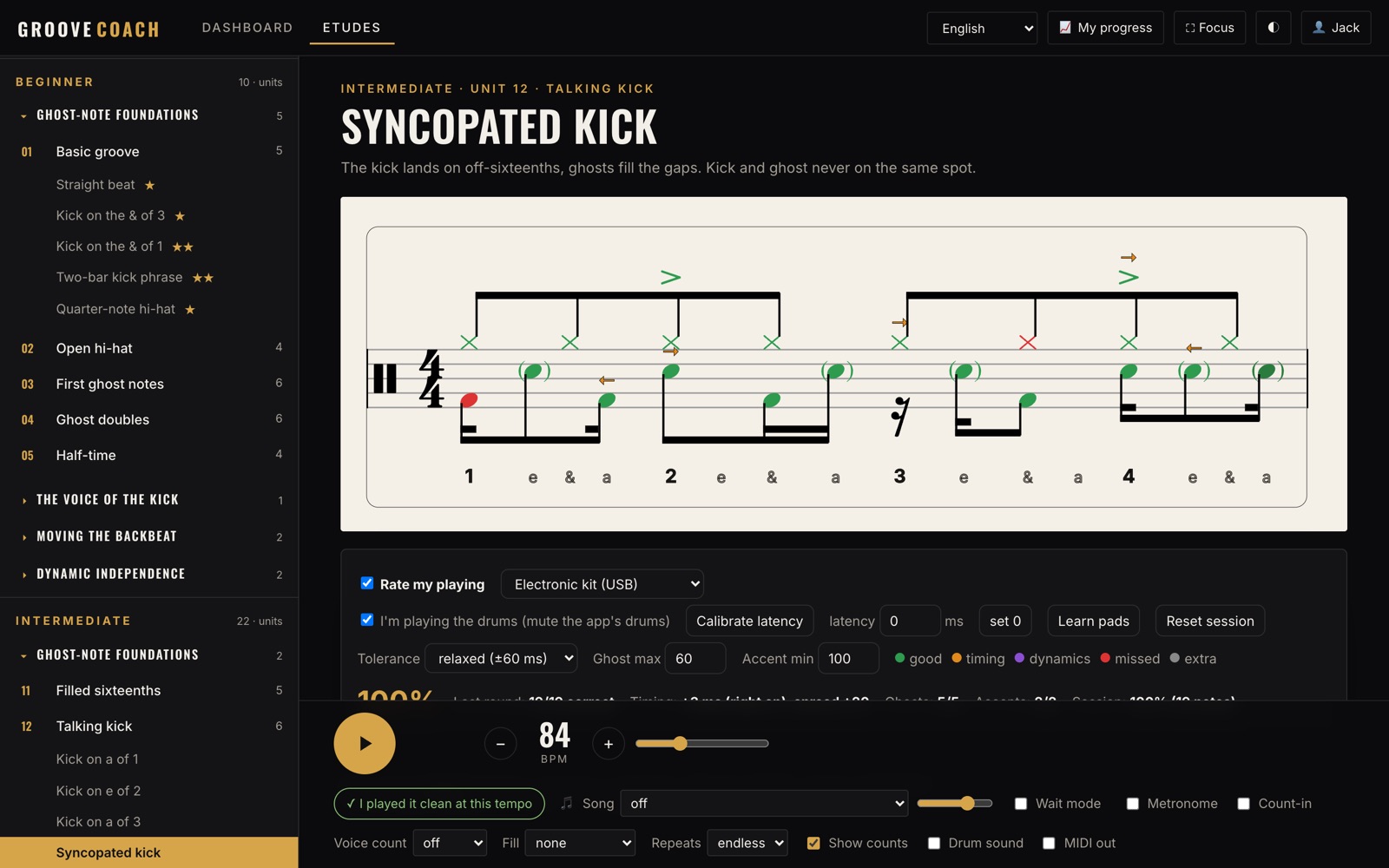
This course is made of short pieces that sound and look impressive: linear grooves where hands and feet never play together, dense ghost-note funk, tribal tom grooves and fast two-footed kick patterns.
A linear groove never stacks two sounds on the same sixteenth. Each spot in the bar belongs to exactly one limb, so the groove sounds clean and almost electronic. The skill is not speed but evenness: every sixteenth must be equally spaced, even though it moves between hands and foot.
In the example below the right hand plays the hi-hat on every 'e' and 'a', and the left hand plays the snare on the '&'s and on 2 and 4 — ghosts on the '&'s, accents on the backbeats. The kick takes 1 and 3, where the snare would otherwise be. Played slowly, it is simply single strokes, R L R L, with the foot replacing the left hand twice per bar. Start at 60 BPM, count "1 e & a" out loud and make sure no two notes ever sound together.
Dense funk grooves sound impressive because of the gap between loud and soft. The backbeat is full, from 25–30 cm; the ghosts drop from 2–3 cm and stay low. If ghosts and accents are close in volume, a busy groove just sounds messy. If you need to build that control first, work through the ghost-note course.
Here the right hand plays sixteenths on the hi-hat. The left hand adds ghosts on the '&' of 1, the '&' of 2, the 'a' of 3 and the '&' of 4 around the backbeats. The kick plays 1, then the 'e' and '&' of 3 as a double, and the 'a' of 4 as a pickup into the next bar. Learn hi-hat, snare and kick in that order, and keep the hi-hat exactly the same when the kick double arrives.
In a tom groove the floor tom takes the job of the hi-hat. In the first etude the right hand plays the floor tom on 1, the '&' of 1, the '&' of 2, 3, the '&' of 3 and the '&' of 4, with accents on 1 and 3. The snare stays on 2 and 4, and the kick plays 1, 3 and the 'a' of 3. The tom and the snare never meet, so one hand can play the tom line while the other plays only the backbeats.
The sound depends on two levels on the tom: the accents from high, the other notes from low. In later etudes the high and middle toms join in, and each tom must keep its own pitch. Tune them clearly apart and hit the centre of each head; a tom played off-centre sounds dull and the melody gets lost.
Double-pedal kick: two feet, one even line
The first double-pedal etude has the kick on every sixteenth except beats 2 and 4, where the snare plays alone, and the hi-hat on quarters. The simplest way to keep it even is to fix the lead: right foot on the numbers and '&'s, left foot on every 'e' and 'a'. Under the backbeat the right foot simply leaves out its stroke and comes back on the '&'.
Start at 50–60 BPM and play only the feet, counting "1 e & a". Record yourself: the left foot is usually weaker and a little late. Bring the left foot up to the right before adding the hands. If you have no double pedal, practise the same sixteenths with one foot at a slower tempo; the timing problems are the same, and the kick course covers one-foot doubles.
Gospel chops: thinking in sextuplets
Gospel chops are built on sextuplets: six even notes per beat, best counted as two triplets, "1 la li & la li". The example below repeats one six-note cell on every beat: an accented snare stroke, three ghosts, then two kicks — R L R L K K. On beat 1 the crash and kick replace the accented snare.
Practise the cell alone first, on one beat, with a long rest after it. Then string four together at 50–60 BPM, where each note is still easy to place. The two kicks are the usual weak spot: they must be as loud and as even as the hand notes, so the cell sounds like one smooth line rather than hands followed by a stumble. Only when four cells in a row are clean, move up 5 BPM at a time.
A grouping is a short cell that repeats without lining up with the beat. In the example below the cell is three sixteenths long: kick (with the hi-hat), hi-hat, accented snare. Three does not divide sixteen, so the snare accents land on the '&' of 1, the 'e' of 2, 3, the 'a' of 3 and the '&' of 4. After two bars the cell has drifted, and bar 2 begins on its second note, the hi-hat.
The illusion only works if you keep the real count. Play the cell slowly while counting "1 e & a" out loud, and check that your count still lands on 1 at the start of each bar. A metronome on quarters is essential here. Once threes feel natural, cells of 5 and 7 work the same way, they just take longer to come back around.
Linear notes that flam. If you hear two sounds on one sixteenth, a limb is late. Slow down until every note stands alone.
Ghosts growing into accents. In dense funk the left hand tends to lift higher. Keep the tip low between backbeats.
A weak left foot. On double pedal, record yourself and compare both feet before you speed up.
Rushing the kicks in gospel chops. The two kicks often come early and close together. Count the sextuplets out loud.
Losing beat 1 in groupings. If you follow the cell instead of the count, the bar line disappears. Keep counting quarters.
A one-week plan
Days 1–2: the linear groove at 60 BPM, then 70, two minutes without stopping; listen for flams.
Day 3: the ghost-note funk groove in layers — hi-hat and snare first, then kick — at 65–75 BPM.
Day 4: the floor-tom groove at 70 BPM, then double pedal with feet alone at 50–60 BPM.
Days 5–6: one gospel cell on one beat, then four in a row at 50–60 BPM.
Day 7: the three-note grouping over two bars at 60 BPM, counting out loud; record it and check where bar 2 starts.
Frequently asked questions
What is a linear drum groove?
A groove in which no two drums or cymbals are played at the same time. Every note belongs to one limb, so hands and feet take turns. It sounds clean and tight and is common in funk and fusion.
How do you count gospel chops?
Most gospel chops are sextuplets, six notes per beat. Count them as two triplets, "1 la li & la li", and practise one beat at a time before linking them.
How fast should I play show-off grooves?
Only as fast as you can play them evenly. Start around 50–70 BPM and add 5 BPM at a time; a clean groove at a medium tempo sounds better than a rushed one at full speed.
Later units bring a Purdie-style half-time shuffle, gospel chops in sextuplets and groups of 3, 5 and 7 that cross the bar line. Film yourself with the app's video recorder and share it — the notes light up on screen as you play.
What you'll learn
Clean linear grooves and strong ghost-to-backbeat contrast
Gospel chops in sextuplets and fast kick patterns
Rhythmic illusions with groupings across the bar
Who it's for
Drummers who are comfortable with basic grooves and want showpieces to add to their practice and share online.
Hands and feet never play at the same time — one voice on every sixteenth. That's what makes it sound so clean and slick. Start slow and play every note evenly.
Etude 1
Etude 2
Etude 3
Etude 4
Etude 5
02Ghost-note funk5 etudes
Strong backbeat, whispered ghosts — the show is in that contrast. Close the open hi-hat cleanly on the next beat.
Etude 1
Etude 2
Etude 3
Etude 4
Etude 5
03Tom grooves4 etudes
The toms sing the melody; the snare plays only on 2 and 4. Hit the accented toms hard and the rest lightly, and keep each tom's pitch clearly apart.
Etude 1
Etude 2
Etude 3
Etude 4
Advanced
04Fast kick (double pedal)4 etudes
Both feet take turns at equal strength: right-left-right-left. Start very slowly and speed up only when both feet sound the same. Keep the hands relaxed.
Etude 1
Etude 2
Etude 3
Etude 4
05Purdie-style half-time shuffle4 etudes
Half-time in a triplet feel: backbeat only on 3, soft ghosts on the middle partials in between. The hi-hat's sway is the soul of the groove.
Etude 1
Etude 2
Etude 3
Etude 4
06Gospel chops5 etudes
Fast phrases in sextuplets, moving between snare, toms and kick. Play them clean at half tempo first — speed comes after clarity.
Etude 1
Etude 2
Etude 3
Etude 4
Etude 5
07Groupings across the bar4 etudes
Cells of 3, 5 and 7 repeat over two bars and slide across the bar line. Keep counting: beat 1 lands on a different note of the cell every bar.
Etude 1
Etude 2
Etude 3
Etude 4
How you practise
Every etude is real notation, like in a book. You play with a metronome, spoken counting and a tempo ladder; your e-kit or microphone listens to every stroke and colours the notes green, orange or red. In a tricky bar, wait mode pauses until you hit the right drum.