In this course the hands stay put like a wall and only the foot sings the melody. First the kick lands on the numbers and '&'s; then it reaches the 'e' and 'a', and then come doubles — two strokes played in a single motion.
In the later units a kick figure (for example K K . K) slides one sixteenth to the right with each etude until it has visited every spot in the bar. Instead of memorising, you slide: same figure, new place. By the end you can drop the figure anywhere into any groove.
Drummers whose foot lags behind their hands, or who only ever play the kick on 1 and 3.
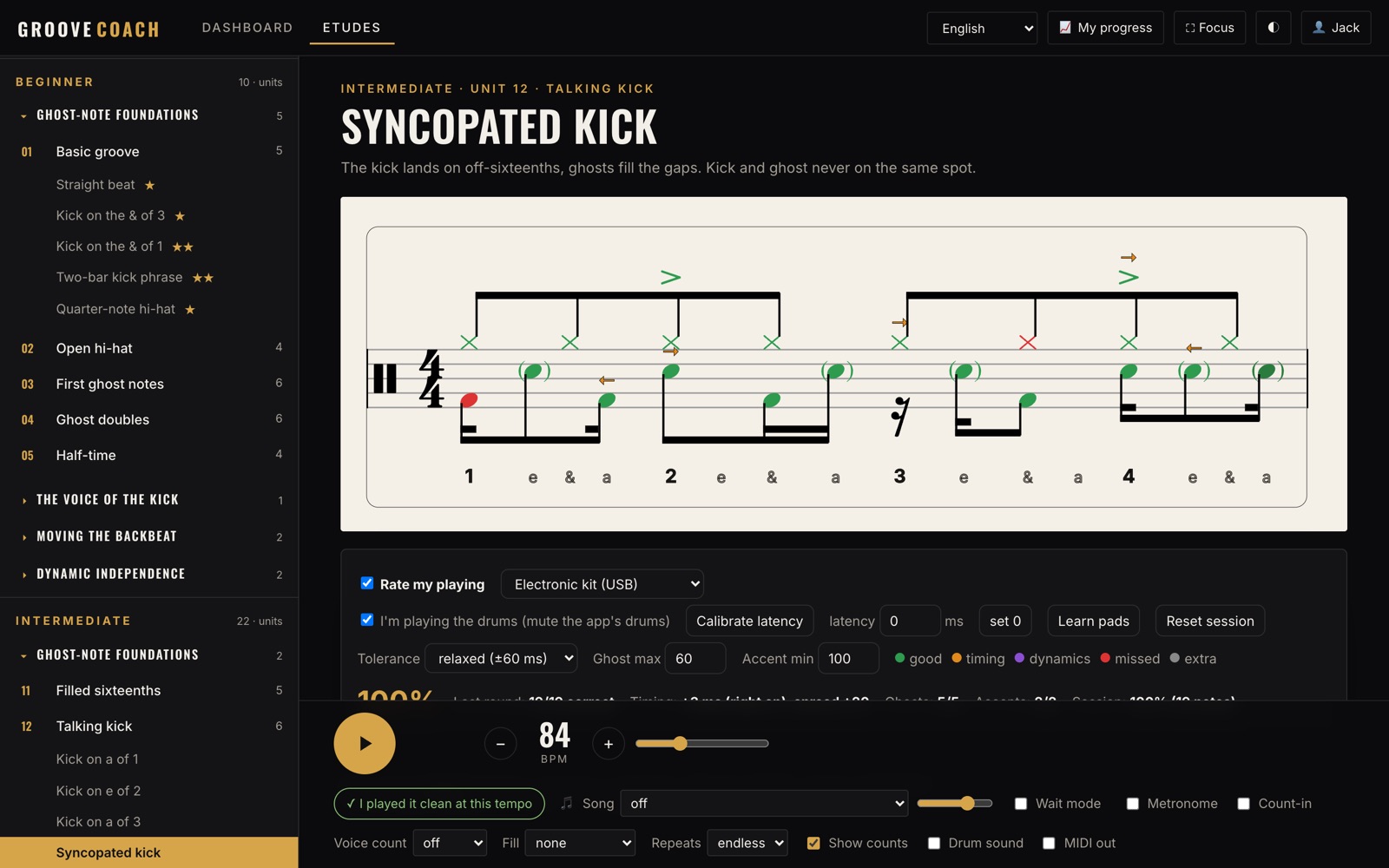
The hands are a steady wall; only the foot sings the melody. The kick lands on numbers and '&'s only. Count the kick out loud on its own first, then add the hands.
Now the foot reaches the 'e' and 'a' too. The key shape is long-short: 1 . . a. Keep each kick short and punchy — don't bury the beater, so the foot is ready for the next note.
The double steps up into the next beat like a stair: 'a-1', 'a-3'. The goal isn't the double, it's the beat it lands on. Play that beat a little stronger — the double is just the run-up.
This time the target is the '&': 'e-&'. The second note lands together with the hi-hat — that unison should sound crisp. Mix these with the previous unit's doubles to build your own phrases.
Two strokes, one motion: the first from the ankle, the second from the rebound. The second note always leans into something — hear where. At a slow tempo, make both notes equally loud.
Figure: two kicks on consecutive 16ths. Each etude slides the figure one 16th to the right until it has visited every spot in the bar; then you drop it anywhere into a plain groove. Don't memorise — slide: same figure, new place. In the half-time etudes the snare plays only on 3.
The double starts on the '&' and ends on the 'a': '&-a'. Don't rush as you approach the backbeat — the 'a' sits exactly in place. Finish by combining every double placement in one groove.
'1-e', '3-e': the double starts right on the beat and pulls away. The hardest spot is a double starting with the snare (2-e, 4-e). Don't let the hands freeze — the foot lives its own life.
Figure: kick, gap, two kicks. Each etude slides the figure one 16th to the right until it has visited every spot in the bar; then you drop it anywhere into a plain groove. Don't memorise — slide: same figure, new place. In the half-time etudes the snare plays only on 3.
Figure: two kicks, gap, kick. Each etude slides the figure one 16th to the right until it has visited every spot in the bar; then you drop it anywhere into a plain groove. Don't memorise — slide: same figure, new place. In the half-time etudes the snare plays only on 3.
Figure: two kicks, gap, two kicks — two doubles back to back. Each etude slides the figure one 16th to the right until it has visited every spot in the bar; then you drop it anywhere into a plain groove. Don't memorise — slide: same figure, new place. In the half-time etudes the snare plays only on 3.
Figure: kick, gap, two kicks, gap, kick — a double wrapped in two singles. Each etude slides the figure one 16th to the right until it has visited every spot in the bar; then you drop it anywhere into a plain groove. Don't memorise — slide: same figure, new place. In the half-time etudes the snare plays only on 3.
Every etude is real notation, like in a book. You play with a metronome, spoken counting and a tempo ladder; your e-kit or microphone listens to every stroke and colours the notes green, orange or red. In a tricky bar, wait mode pauses until you hit the right drum.
How to play ghost notes on drums: 44 notated etudes, from first soft strokes to linear grooves, with live feedback from your e-kit or microphone.
9 units · 44 etudes →Play the backbeat early, late and doubled: 221 notated etudes that teach you to move the snare around — ending up in drum & bass. Live feedback.
10 units · 221 etudes →Right hand plays rhythm cells on the hi-hat, left hand ghosts, the foot moves freely: 102 notated etudes for drum independence, with live feedback.
9 units · 102 etudes →15 hi-hat patterns, the most natural spots for a ghost note and double-ghost building blocks: 55 notated etudes to grow your groove vocabulary.
4 units · 55 etudes →Drum and bass on an acoustic kit: short and long hand figures, a skeleton shifted onto the upbeats, broken beats. 116 advanced notated etudes.
10 units · 116 etudes →Flowing grooves built on R-L-L-R inverted doubles: groups of 4 and 2, adding the kick, shifting accents. 49 notated etudes with live feedback.
6 units · 49 etudes →Split every beat in three: half-time triplet grooves, triplet double backbeats, kick phrases in a triplet feel. 42 notated etudes with live feedback.
4 units · 42 etudes →Try it free for 14 days — no card needed.
Try it free for 14 days