The backbeat — the snare on 2 and 4 — is the spine of a groove. This course moves it on purpose: first you delete a backbeat and listen to the hole, then you give it an 8th-note companion, then you play it an 8th late or early. The groove seems to stumble — and that's a decision, not a mistake.
At the advanced level the shifts shrink to sixteenths: backbeats that arrive early on the 'a' or slip to the 'e'. The final unit starts from a plain groove and moves one note to the right at every step — by the end you're inside drum & bass.
Drummers with solid time who want their grooves to sound more surprising and modern.
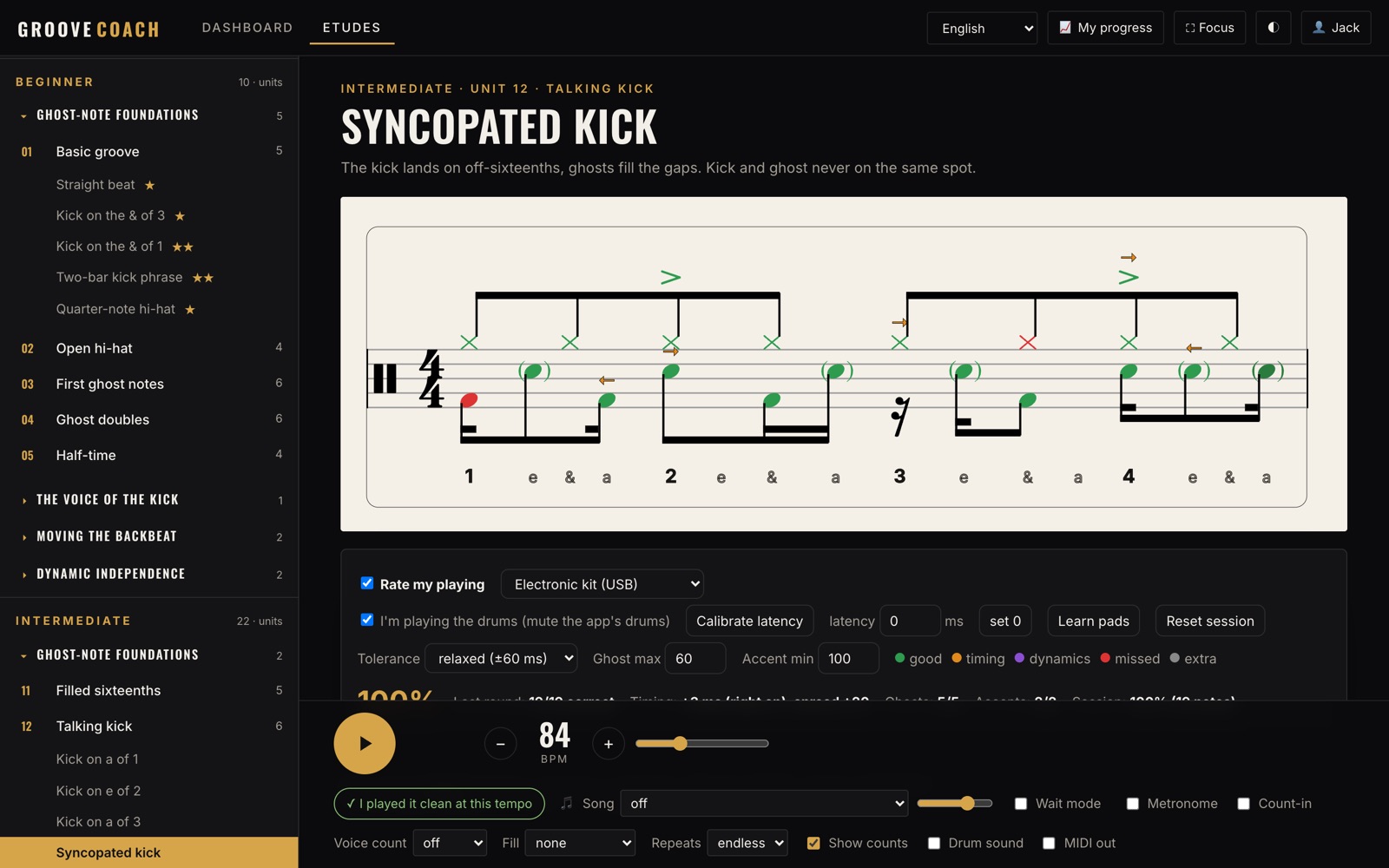
The snare ticks on all four beats like a clock; the kick fills the gaps — first in 8ths, then in 16ths. The snare never wavers: it is your metronome.
Delete one backbeat and let the hole speak: first the 4, then the 2. Count the silence too — a rest should be as clear as a played note.
Give the backbeat an 8th-note companion, just before or just after. The real backbeat is strong, the companion a touch softer. Never let your ear confuse which one is the 'real' one.
The backbeat comes an 8th late: '&' of 2 instead of 2. The groove seems to stumble — that's a decision, not a mistake. Count the beat, wait for the snare, and let the tension build.
This time an 8th early: '&' of 3 instead of 4. The snare can't wait. Fill the gap that opens behind it with kick or ghost notes.
In two-bar phrases some backbeats move an 8th earlier or later. Before playing, say out loud which one moves — what's solved in the head becomes easy in the hands.
Now the double is in 16ths: the right hand leaves the hi-hat for a moment to join the snare. Automate the sticking (R-L, L-R, L-R-L) slowly — there's no time to think at speed.
The backbeat arrives one 16th early, on the 'a' of the beat before: '1 e & A'. Like a hiccup — the snare has already spoken before 2 arrives. Keep the hi-hat straight; only the snare moves.
The subtlest shift: just one 16th late, on the 'e' of 2. It feels like a tiny stagger. This is where hi-hat and snare split apart — don't let one hand follow the other.
Start from a plain two-bar groove and move one note an 8th to the right at each step. By the end you're inside drum & bass. Don't move on until each step feels like a groove of its own.
Every etude is real notation, like in a book. You play with a metronome, spoken counting and a tempo ladder; your e-kit or microphone listens to every stroke and colours the notes green, orange or red. In a tricky bar, wait mode pauses until you hit the right drum.
How to play ghost notes on drums: 44 notated etudes, from first soft strokes to linear grooves, with live feedback from your e-kit or microphone.
9 units · 44 etudes →Free up your bass drum foot: kick melodies in 8ths and 16ths, kick doubles and sliding figures. 275 notated etudes with live feedback.
12 units · 275 etudes →Right hand plays rhythm cells on the hi-hat, left hand ghosts, the foot moves freely: 102 notated etudes for drum independence, with live feedback.
9 units · 102 etudes →15 hi-hat patterns, the most natural spots for a ghost note and double-ghost building blocks: 55 notated etudes to grow your groove vocabulary.
4 units · 55 etudes →Drum and bass on an acoustic kit: short and long hand figures, a skeleton shifted onto the upbeats, broken beats. 116 advanced notated etudes.
10 units · 116 etudes →Flowing grooves built on R-L-L-R inverted doubles: groups of 4 and 2, adding the kick, shifting accents. 49 notated etudes with live feedback.
6 units · 49 etudes →Split every beat in three: half-time triplet grooves, triplet double backbeats, kick phrases in a triplet feel. 42 notated etudes with live feedback.
4 units · 42 etudes →Try it free for 14 days — no card needed.
Try it free for 14 days