In this course the right hand 'sings' small two-beat rhythm cells on the hi-hat while the left hand fills the gaps with ghost notes. Then the kick is set free, and after that it's locked into one fixed pattern: above, the cell changes; below, the foot stays put.
In the advanced units two different cells share a bar, the kick shadows the right hand, and the backbeat moves to a new home to fit the cell. The rule is simple: fit the backbeat to the cell, never break the cell.
Intermediate drummers who struggle to keep their limbs apart.
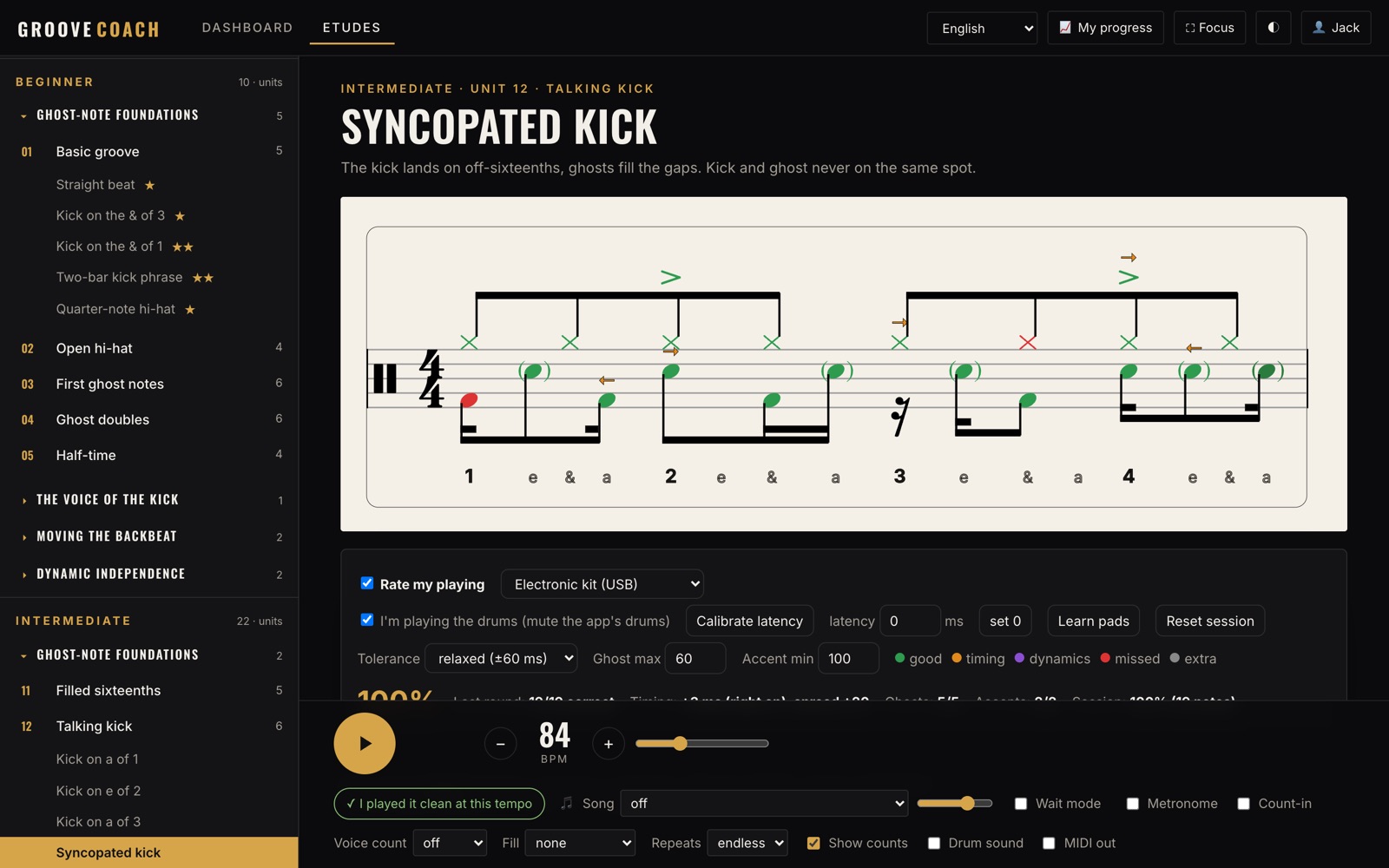
Small two-beat rhythm cells: the right hand sings the cell on the hi-hat, the left hand fills the gaps with ghost notes. Kick on 1, accent on 3 — half-time. The right hand is the melody, the left its shadow.
No ghost notes: the right hand plays the cell, the snare plays 3, and the kick is free. Over two bars, find spots under or between the hi-hat notes — try a new spot every repeat.
The kick no longer follows the right hand; it repeats one fixed pattern. Above, the cell changes; below, the foot stays put — the first real step in independence.
Drop extra snare accents into the gaps of the hi-hat. Accents use the holes in the cell; the right hand never stops. Less is more — one or two per bar is plenty.
One cell in the first half of the bar, a different one in the second. The switch happens right on 3 — sing the right hand's new pattern in your head one beat ahead.
The kick plays together with the hi-hat, two limbs sounding as one. Ghost notes stay in the gaps. Make sure kick and hi-hat land exactly together — no flams.
The kick shadows the right hand only after the backbeat; the first half of the bar stays calm. The phrase starts simple and ends busy. Don't rush the first half and the second will feel easy.
The mirror image: the kick shadows the right hand in the first half and goes quiet after the backbeat. Busy start, simple ending. Holding back after the backbeat matters as much as playing.
If beat 3 is taken by the cell, the backbeat moves to the nearest gap — just before or just after. The rule: fit the backbeat to the cell, never break the cell for the backbeat.
Every etude is real notation, like in a book. You play with a metronome, spoken counting and a tempo ladder; your e-kit or microphone listens to every stroke and colours the notes green, orange or red. In a tricky bar, wait mode pauses until you hit the right drum.
How to play ghost notes on drums: 44 notated etudes, from first soft strokes to linear grooves, with live feedback from your e-kit or microphone.
9 units · 44 etudes →Free up your bass drum foot: kick melodies in 8ths and 16ths, kick doubles and sliding figures. 275 notated etudes with live feedback.
12 units · 275 etudes →Play the backbeat early, late and doubled: 221 notated etudes that teach you to move the snare around — ending up in drum & bass. Live feedback.
10 units · 221 etudes →15 hi-hat patterns, the most natural spots for a ghost note and double-ghost building blocks: 55 notated etudes to grow your groove vocabulary.
4 units · 55 etudes →Drum and bass on an acoustic kit: short and long hand figures, a skeleton shifted onto the upbeats, broken beats. 116 advanced notated etudes.
10 units · 116 etudes →Flowing grooves built on R-L-L-R inverted doubles: groups of 4 and 2, adding the kick, shifting accents. 49 notated etudes with live feedback.
6 units · 49 etudes →Split every beat in three: half-time triplet grooves, triplet double backbeats, kick phrases in a triplet feel. 42 notated etudes with live feedback.
4 units · 42 etudes →Try it free for 14 days — no card needed.
Try it free for 14 days